
Co-Ed Baby Shower Games for Couples and Mixed Groups
Direct answer: The best co-ed baby shower games are team games, couple-vs-couple contests and short relays that reward speed, guessing and teamwork rather than baby knowledge. Pick three or four, mix one active relay with one seated guessing game, keep every round under ten minutes, and let guests opt in.
A co-ed baby shower is a different party from a traditional women-only shower, and the games need to be different too. When dads-to-be, brothers, partners and male friends are in the room, the games that fall flat ask grown adults to sit quietly and guess the flavour of melted chocolate in a diaper, or to decorate a onesie while everyone else watches. The games that work are the ones that work at any good party: a little competition, a little teamwork, a clear winner, and a reason to laugh together.
This guide gives you nine co-ed baby shower games — couple-vs-couple showdowns, team relays, and seated table games — that need little more than supplies you probably already own.
What Makes a Game Work at a Co-Ed Shower
First, the game should reward something everyone has: speed, guessing, teamwork and general knowledge. Deep baby knowledge is not fair ground — it hands the win to the most experienced parent in the room. Team games fix this: pair a new dad with a grandmother and the knowledge balances out.
Second, people should play in pairs or teams, not alone in front of the room. Solo performances are where embarrassment lives; the same guest who would refuse to act alone will happily shout answers from a team of four. Teams also get strangers talking: at a co-ed shower the two families and the couple’s friends often do not know each other yet.
Third, keep it short — ten minutes for an active game, five to seven for a seated one. If a game needs a long explanation, it is the wrong game. Fourth, make participation optional, with one or two games running in the background all party long so shy guests can join in without a spotlight.
Do not let couples play as couples in every game, and do not let the men form one team and the women another. Shuffle the teams for each game so guests meet new people every round.
Couple-vs-Couple Games
1. He Said, She Said
Ask the mom-to-be and dad-to-be fifteen questions separately before the shower: who handles the 3 a.m. feeds, who cries first at school drop-off, who lets the baby skip bath night. At the party, read each question aloud and have the couple guess their partner’s answer. Guests vote before the reveal; the couple scores a point per match. It needs no baby knowledge — only opinions about the couple. Keep questions kind — never about money or in-laws.

2. Change the Baby — The Tied-Hands Challenge
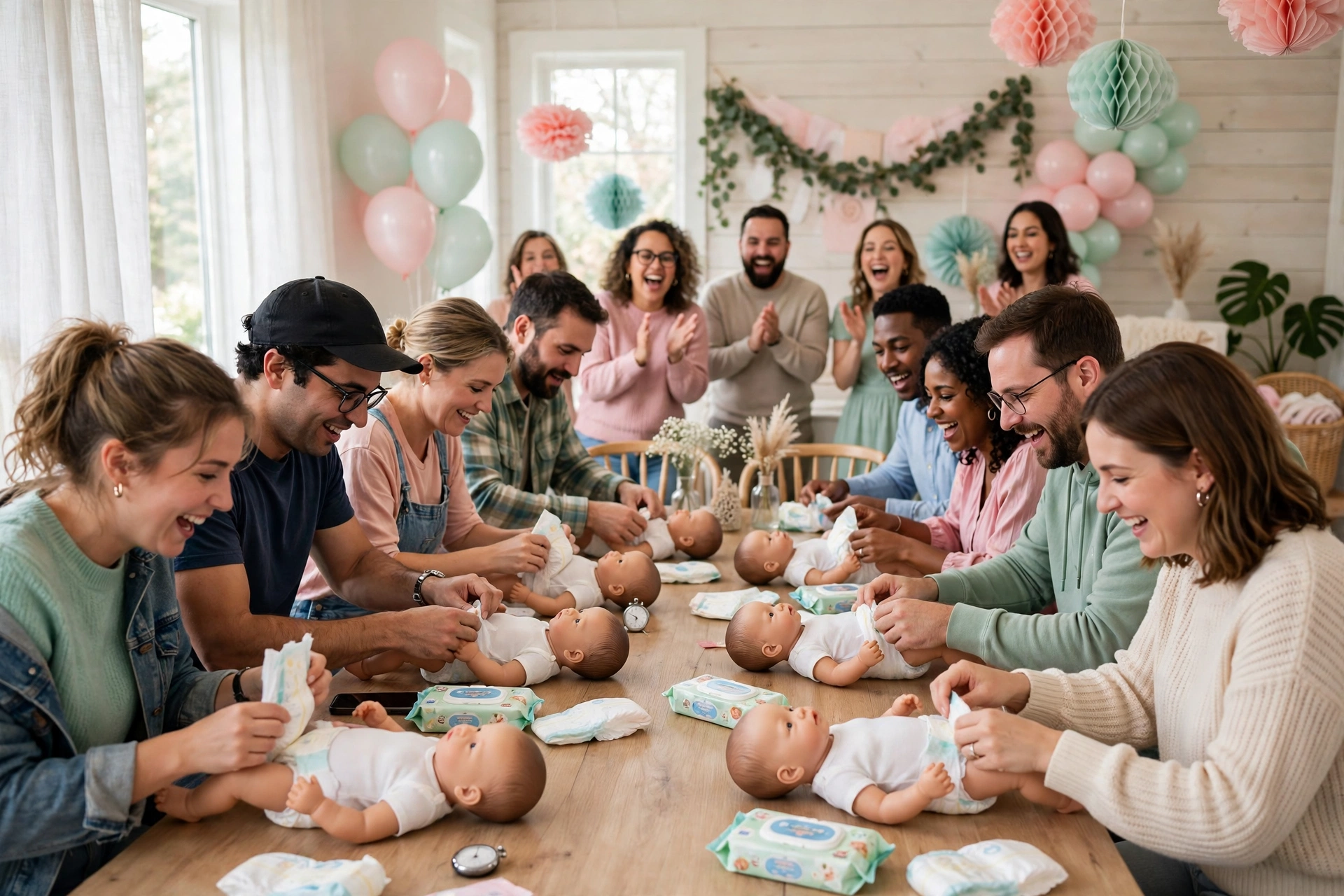
Tie each couple’s inside hands together, so one partner can only use their left hand and the other only their right. Their task: change a baby doll’s diaper and dress it in a onesie against the clock. Fastest couple wins, with a time penalty for a backwards diaper. The tied-hands twist makes it a teamwork test, not a baby-knowledge test. Run it head-to-head between two couples at a time, with the mom-to-be as judge or timekeeper.
3. Baby Name Negotiation
Give each couple twelve unusual real baby names and five minutes to negotiate down to their top three. Each couple presents its final three and argues the case for each one, and the parents-to-be vote on the best pitch, not the best name. It is an argument game, and couples argue well in front of a friendly audience. Keep the names playful but not cruel: the joke is about the names, never about a guest.
4. The Parents-to-Be Quiz Show
Split the room into two teams, each captained by a parent-to-be. The host asks questions about the couple — their first date, their worst cooking disaster, their wedding song — and about the baby: the due date, the nursery theme, the name shortlist. Teams buzz in or write answers on small whiteboards; first to ten points wins. Half the questions are about people the guests know, which is why it fits a mixed crowd better than straight baby trivia. Run three rounds of five questions, with a final wager round.
Team Relays
5. Diaper Derby Relay
Split guests into teams of four or five. Each player runs to the changing station and completes one step of a diaper change on a baby doll: unfasten, wipe, powder, fasten, snap the onesie shut. Then they tag the next player. The fastest team wins; for an extra challenge, have players wear winter gloves or oven mitts. The relay format makes it co-ed friendly: nobody does the whole change alone, each person does one small job, and the team carries the pressure. Keep the course short, so older guests and the mom-to-be can join in.
6. Balloon Bump Waddle Relay
Give every player a balloon to blow up and tuck under their shirt. In teams, players take turns waddling to a pot while balancing a coin or a ping-pong ball on a spoon, and dropping it in. If the balloon pops or the ball drops, the player starts again. The first team to get every player through wins. This is the silliest game in this guide, and the one that photographs best, because the joke is on everyone equally. Keep it optional and the course clear of furniture; anyone who does not want to waddle can be the team’s timer or scorekeeper.
Relays need energy, and a hungry room has none. Serve food first, let guests eat and settle for fifteen minutes, then announce the relay.
Seated Table Games
7. Baby Gear Price Is Right
Show the room eight to ten everyday baby items — nappies, a monitor, a swaddle set, a bottle steriliser, a sleep sack, a car seat — and have each team guess each price. The team whose total is closest to the real total wins. Use real prices from a shop the parents use, and include one item that shocks everyone: the car seat or the monitor usually does it. It runs on real-world adult skills — shopping, estimating, arguing about whether a bottle warmer can really cost that much — rather than baby knowledge. That is exactly why our guide to how much a baby shower costs is worth a read before you set your own budget.
8. Baby Photo Match
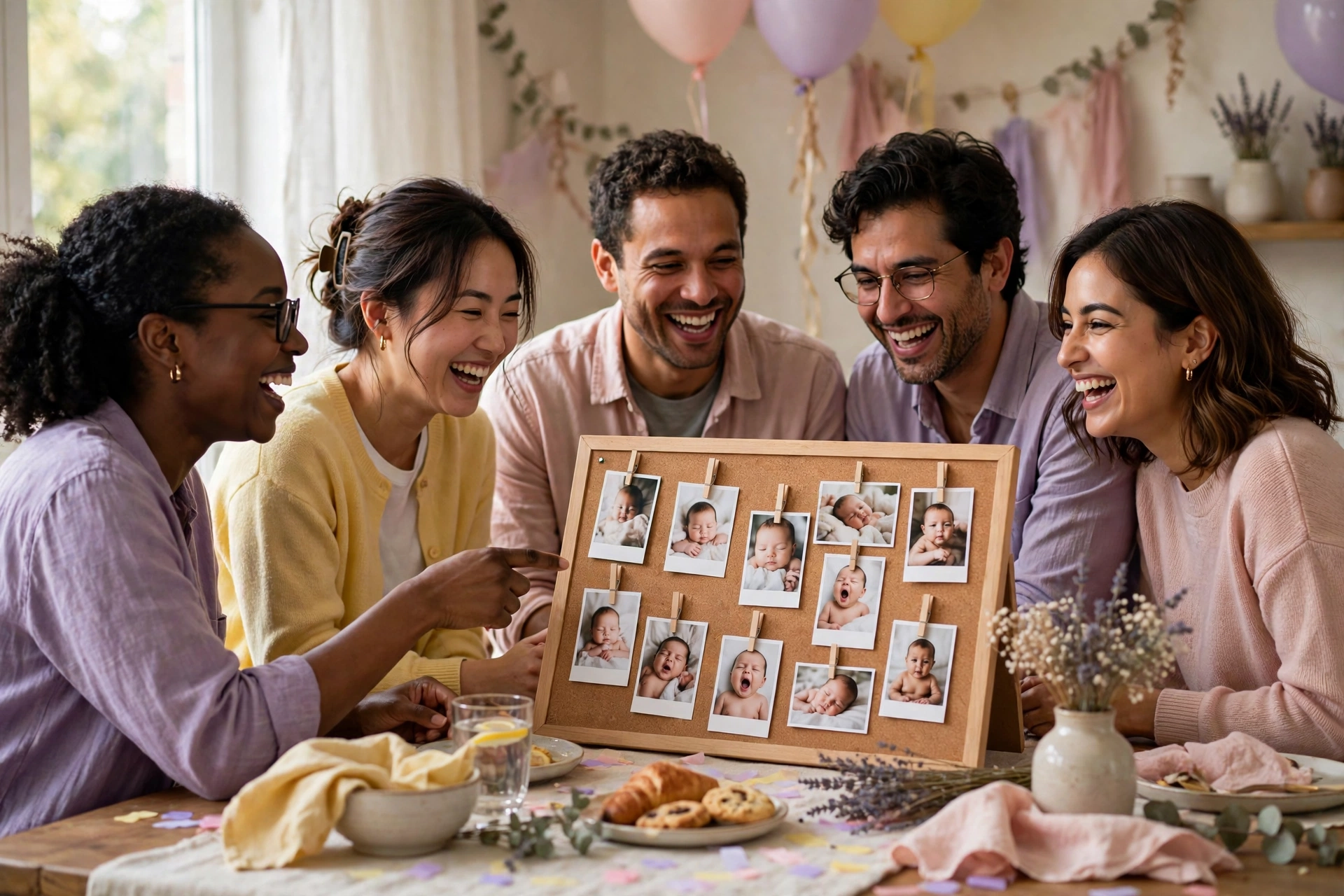
Before the shower, ask every guest to send in a baby photo. Print the photos, number them, and pin them to a board. Guests get a numbered sheet and have the whole party to match each baby photo to the right adult. The guest with the most correct matches wins, and the reveal — usually just before cake — is always the loudest moment of the day. It works beautifully for mixed groups, because it gives strangers a reason to talk, and every guest has a personal stake: their own photo is on the board. Prints usually cost only a few dollars, though prices vary by US region and retailer.
The fastest way to kill a co-ed shower is a game that puts one guest on the spot: smelling mystery nappies alone, or acting out a charade in front of the room. If a game only works when one person is the joke, replace it with a team version.
The Background Games That Run All Party Long
A few low-effort games running in the background keep the energy up while the host is busy, and give shy guests a way to play without a spotlight. Baby Bingo during gift opening: hand out bingo cards filled with common gift items — onesie, swaddle blanket, pacifier, monitor, board book — before gifts are opened; the first to complete a line wins. The Name Game: pin a board near the entrance with a grid of baby names and let guests vote for their favorite all party long. Prediction cards: leave cards on each table asking guests to predict the baby’s birth date, weight and first word, and collect them in a box for the parents-to-be.
How Many Games, and in What Order?
Three or four games is the right number for a two- to three-hour shower. More than that, and the party becomes a schedule. A proven order: start with Baby Photo Match from the moment guests arrive, play He Said, She Said once everyone is seated, run one relay — the Diaper Derby or the Balloon Bump Waddle — after food, then finish with Baby Gear Price Is Right while the cake is served. Baby Bingo runs through gift opening. Keep a visible scoreboard — a poster board with team names and tally marks — and announce the winners. Serving cake? See our baby shower dessert table ideas for a spread the winners can celebrate at.

| Game | Group size | Time | Energy level | Works indoors? |
|---|---|---|---|---|
| He Said, She Said | 10–40 | 15 minutes | Low | Yes |
| Change the Baby | 8–30 | 10 minutes | Medium | Yes |
| Baby Name Negotiation | 8–30 | 10 minutes | Low | Yes |
| Parents-to-Be Quiz Show | 12–40 | 15 minutes | Low | Yes |
| Diaper Derby Relay | 12–40 | 10 minutes | High | With space |
| Balloon Bump Waddle Relay | 10–30 | 10 minutes | High | With space |
| Baby Gear Price Is Right | 10–40 | 15 minutes | Low | Yes |
| Baby Photo Match | Any size | All party | Low | Yes |
| Baby Bingo | Any size | During gifts | Low | Yes |
Prizes and Favors That Suit a Mixed Crowd
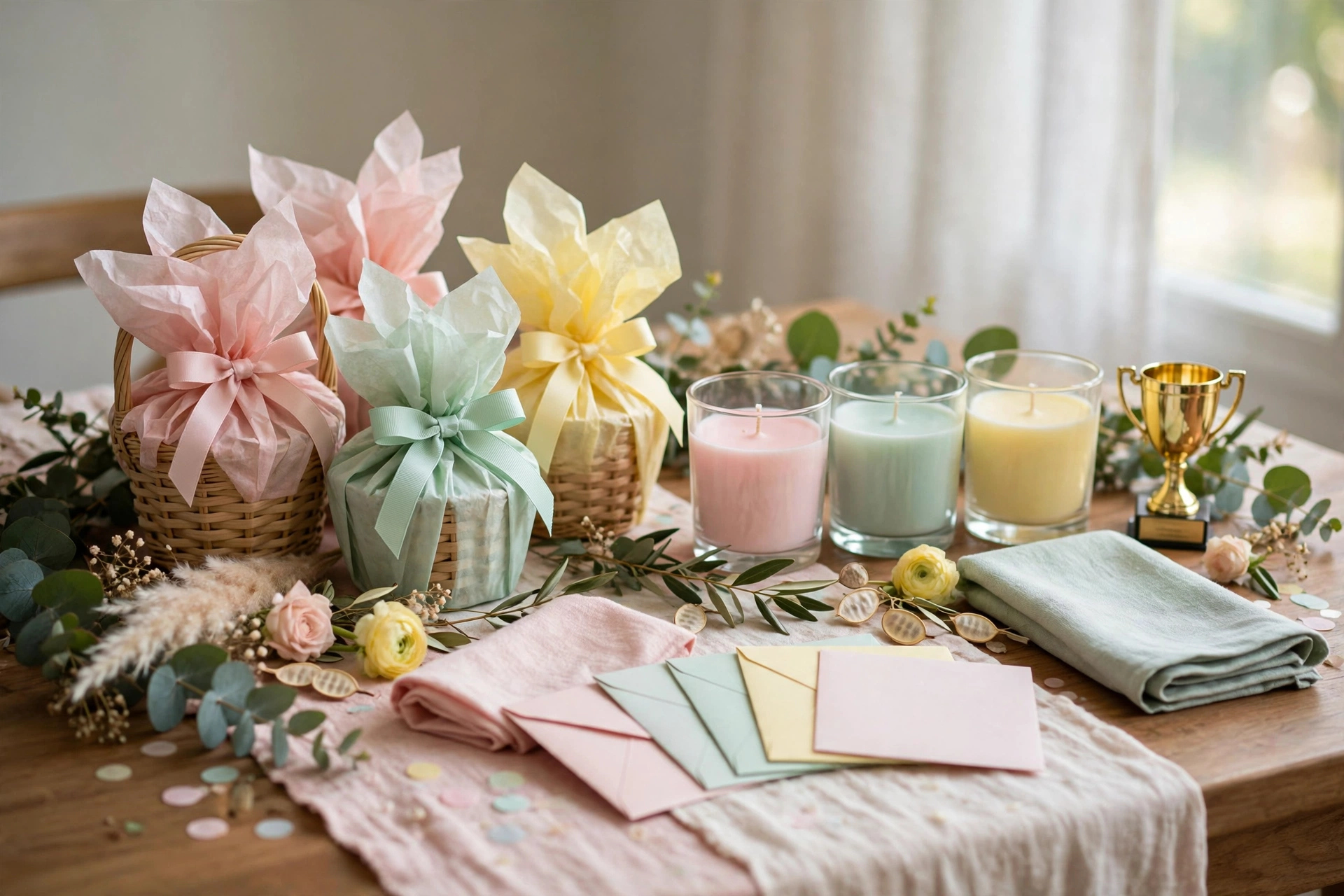
Prizes for co-ed games should be things any adult would actually want: a small box of chocolates, a coffee shop gift card, a scented candle, a bottle of something sparkling, or a funny trophy. Avoid prizes that only suit one gender — nobody wants to win a prize they cannot use. A small prize per game, usually $5–$15, is plenty, and costs vary by US region and retailer. For the overall winning team, one shared prize works better than individual ones: a gift basket, a board game, or a framed team photo. If you need ideas, our guide to group baby shower gift ideas shows how pooling a small amount per person buys a far better gift than anyone could manage alone. Party favors follow the same rule: a small bag of sweets, a mini succulent, or a personalized thank-you note. Hand them out as guests leave.
Setting Up: Space, Supplies and a Simple Schedule
Most of these games need very little: a baby doll or two, a pack of newborn nappies, a few balloons — spares from a DIY baby shower balloon arch are ideal — printed sheets, and a timer on your phone. Buy the supplies a week ahead and test the two trickiest games — the tied-hands diaper change and the balloon waddle — with a friend. Space matters more than supplies. Relays need a clear run of at least a few metres, so pick a room, hallway or garden with space to move. If your venue is small, lean on the seated games instead. Our guide to how to choose the perfect baby shower venue covers space and layout in detail.
Aim for a two- to three-hour party: arrivals and the photo match board first, the first seated game at forty-five minutes, food at the one-hour mark, the relay after food, a second seated game with cake, and gift opening with bingo.
The most expensive props in this guide — a baby doll and a baby monitor for the Price Is Right round — are things your friends already own. Borrow them a week ahead. Most co-ed game supplies cost under $20 this way.
FAQs
What are the best co-ed baby shower games for couples?
The best co-ed baby shower games for couples are He Said, She Said, the tied-hands diaper change, Baby Name Negotiation, and a couple-vs-couple quiz show. Each couple plays as a team, nobody performs alone, and winning depends on teamwork and opinions about the parents-to-be.
How many games should you play at a co-ed baby shower?
Three or four games is right for a two- to three-hour co-ed shower. Add one background game, such as Baby Photo Match or Baby Bingo during gift opening. More than four hosted games turns the party into a schedule, leaving no time for eating, talking and opening gifts.
What baby shower games do men actually enjoy?
Men most enjoy competitive, team-based games: relays like the Diaper Derby and the Balloon Bump Waddle, plus guessing games like Baby Gear Price Is Right and team trivia. Speed, teamwork and general knowledge beat sit-down crafts or games needing deep baby expertise.
How do you make baby shower games less embarrassing?
Make every game a team or couple game so nobody performs alone, keep rounds under ten minutes, make participation optional, and skip any game that singles one guest out. Mixed teams, low stakes and a small prize keep the mood friendly.
What prizes work for co-ed baby shower games?
Small prizes any adult would enjoy work best: chocolates, a coffee shop gift card, a scented candle, or a bottle of something sparkling, usually $5–$15 per prize, with costs varying by US region and retailer. For the overall winning team, one shared prize beats individual prizes.
Final Thought
The best co-ed baby shower games are not a separate species of game. They are good party games with a baby theme: teams instead of solo performances, guessing and speed instead of baby expertise, and short rounds instead of long ordeals. Pick three or four from this guide, mix one relay with one seated game, and let the competition do the rest.
Start here: our guide to how to plan a baby shower walks through the full timeline, and our guide to how many guests to invite will help you size the teams. Choose a theme that suits a mixed crowd — our unique baby shower themes, gender-neutral baby shower themes, boho baby shower ideas and our safari jungle baby shower theme all work well for co-ed parties — and set the room up with our baby shower table decorations. Decorating on a budget? Our budget-friendly baby shower decorations that look expensive will stretch the money further. And when the games are over, a small thank-you goes far — a basket of useful gifts for first-time parents, or affordable baby shower gifts under $50.