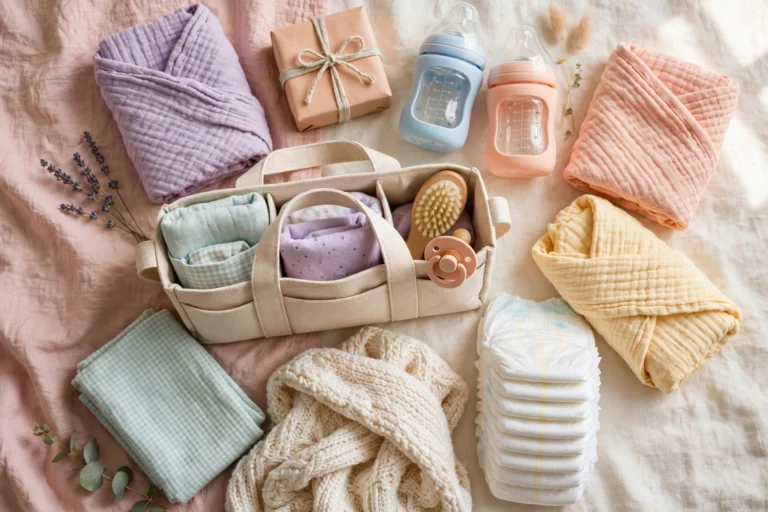
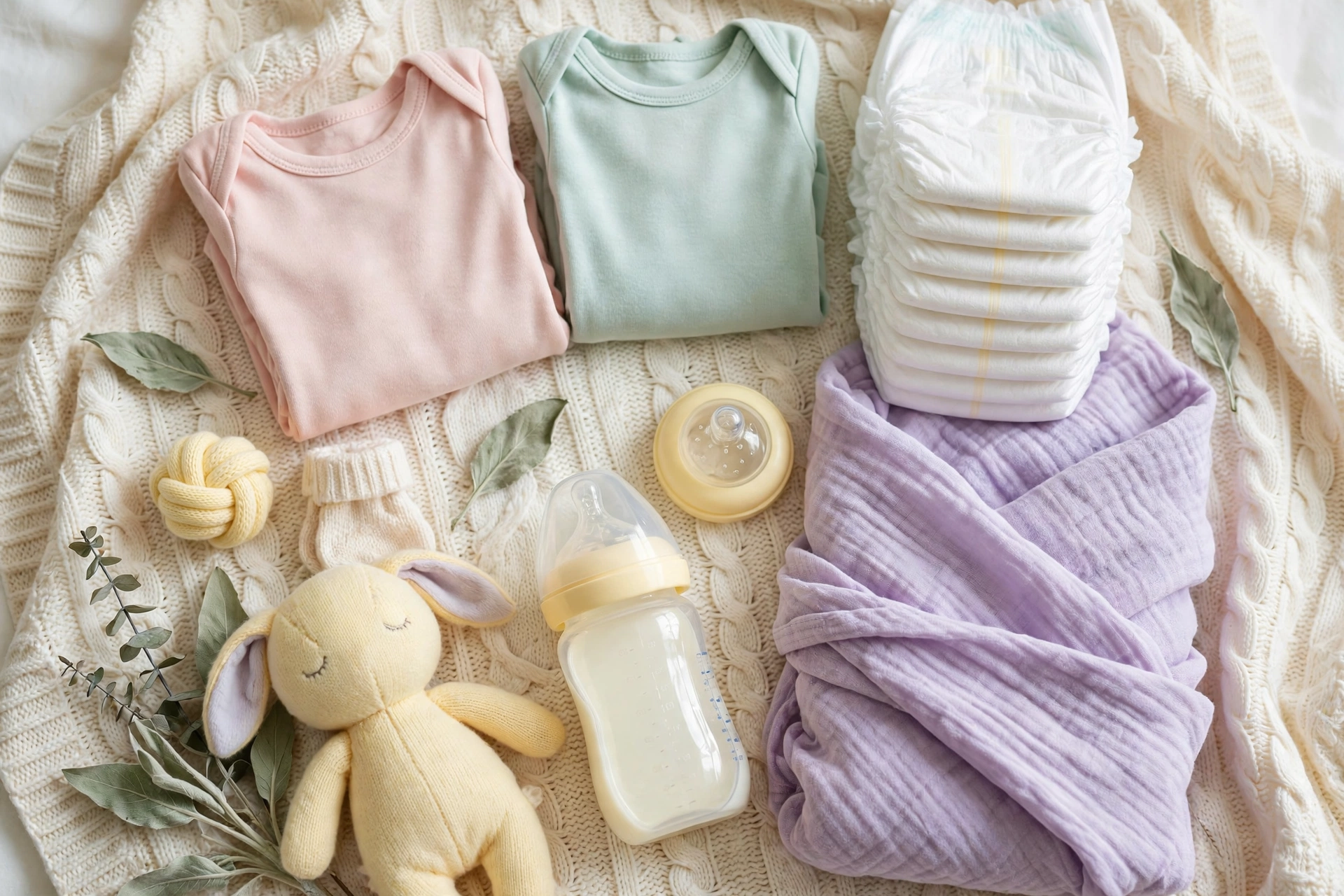
Newborn Essentials Every First-Time Parent Should Have
Direct answer: The newborn essentials for first-time parents are a safe sleep space, an installed car seat, diapers and wipes, a small clothing rotation, feeding supplies, and basic bath and health items. Start with 8–10 diapers a day, 6–10 bodysuits, 4–6 bottles if bottle-feeding, and 2–3 fitted sheets, then buy more only once you know your baby’s size and routine.
Walk into any baby store as a first-time parent and the shelves will tell you that you need everything. You do not. A newborn’s life is sleep, feed, change, repeat, and most newborns rotate through the same 15 to 20 items in the first month; the rest stays in drawers, still tagged.
This checklist gives a quantity range for each item and says honestly what can wait. Quantities assume laundry every two to three days; prices vary by US region and retailer.
How to Use This Checklist: Buy Before Birth vs. Wait
Split the list in two. Pile one is day-one needs: sleep space, installed car seat, diapers and wipes, a few days of clothes, feeding supplies, and a thermometer. Pile two depends on your baby’s size, feeding method or routine — extra bottles, more clothing, a high chair, nursery decor. It can wait, and waiting saves money.
Have pile one ready by about 36 weeks, then stop. If you are planning a shower, our guide to how to plan a baby shower and our baby shower planning checklist for hosts help you time it so the essentials arrive first. For the budget side, see how much a baby shower costs and our affordable baby shower gifts under $50.
Newborn size lasts about 2–4 weeks, and babies over 8 pounds often skip it. Put most clothing money into 0–3 months and buy only 1–2 small packs of newborn diapers.
1. Safe Sleep: The One Category to Get Right First
Sleep is where the newborn essentials for first-time parents matter most, because the wrong purchase here can be unsafe, not just wasteful. The American Academy of Pediatrics (AAP) advises: baby on their back for every sleep, on a firm, flat surface, in a crib, bassinet or play yard meeting Consumer Product Safety Commission (CPSC) standards, with no pillows, blankets, bumper pads or soft toys in the sleep space. Share a room for at least the first 6 months, but do not share a bed.
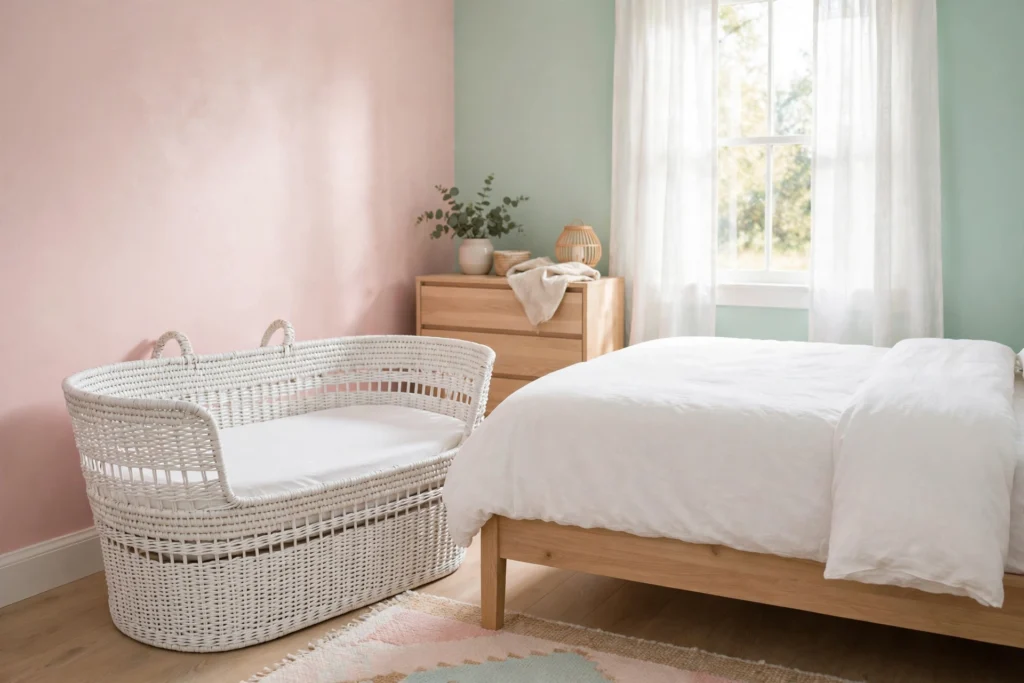
You need one sleep space — a bassinet or crib — with a firm mattress, 2–3 fitted sheets, a waterproof mattress protector, and 2–3 swaddles or sleep sacks. A fitted sheet is all the bedding a newborn needs.
Skip the rest of the sleep aisle. Crib bumpers, quilts, pillows, sleep positioners, nests and pods are not safe for sleep. Inclined sleepers and loungers are not safe sleep surfaces either — if your baby falls asleep in a swing, car seat or carrier, move them to their firm, flat sleep space. Skip weighted sleep sacks too, and stop swaddling when your baby shows signs of trying to roll, often around 3 to 4 months.
2. Diapering: Plan for 8–10 Changes a Day
Diapering is the category parents underestimate most: expect about 8–10 changes a day, with wet diapers reaching about 8 a day by days 3 to 5, plus dirty ones.
Start with 1–2 small packs of newborn diapers and 1–2 small packs of Size 1. Do not buy a case of newborn size before the birth: most babies wear it for only a week to a month, and the hospital usually sends you home with samples. Do not buy the wholesale box of any one brand until you have tried it — fit and skin reactions vary. Keep a small pack of a second brand as a backup.
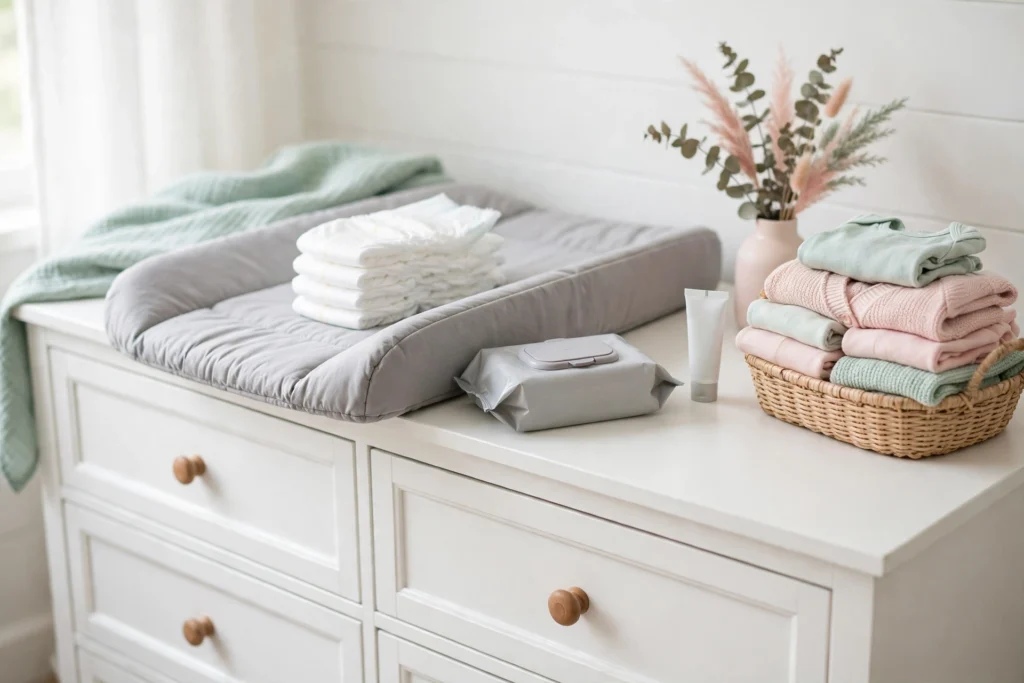
Choose unscented, fragrance-free wipes. Add one tube of diaper cream, a changing pad for a low dresser, and a small lidded bin with liners. If you are considering cloth diapers, try a few types first. Keep one changing station stocked — diapers, wipes, cream, a spare outfit and a washcloth, all within arm’s reach. For ideas on how diapers can be part of a practical present, see our best diaper cake ideas.
Keep a small basket with diapers, wipes, cream and one spare sleeper wherever you feed at night — no trip across the house, no bright light at 3 a.m.
3. Feeding: Start Small, Whatever Your Method
Feeding supplies depend on your plan, and many parents change it in the first two weeks — the best reason to start small. Newborns feed 8–12 times per 24 hours, so your choice will be used constantly.
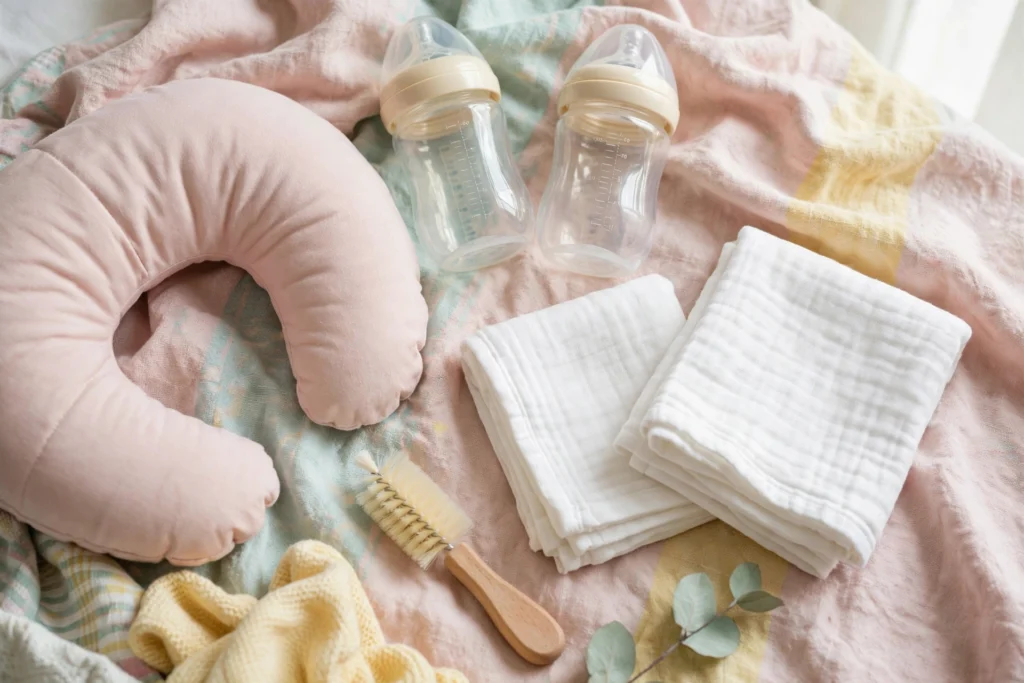
If you plan to breastfeed, start with 2–3 supportive nursing bras, nursing pads, nipple cream, and a nursing pillow — the item parents mention most, supporting your arms and the baby during long feeds. A breast pump can wait until you know whether you will pump regularly.
If you plan to bottle-feed, start with 4–6 bottles with slow-flow nipples, a bottle brush and a drying rack. Buy a small number first: babies often reject a bottle shape or nipple flow, and trying five brands before finding one is a common story. Mostly bottle-feeding means 8–10 bottles eventually; mostly breastfeeding means 3–5 are enough for occasional expressed-milk feeds.
Whatever your method, stock 6–10 burp cloths — the most-used item in the house after diapers: over shoulders, under chins, on laps, and as an emergency wipe for everything. Keep them in three places — nursery, living room and diaper bag — not in one neat pile you never reach.
4. Clothing: 6–10 Bodysuits and a Rotation That Works
Newborn clothing is where first-time parents overbuy most, because each piece looks small, sweet and cheap. The reality: a newborn needs 2–3 outfit changes a day, and 5–6 on messy days. The right wardrobe is a small rotation that survives the laundry cycle, not a closet full of outfits.
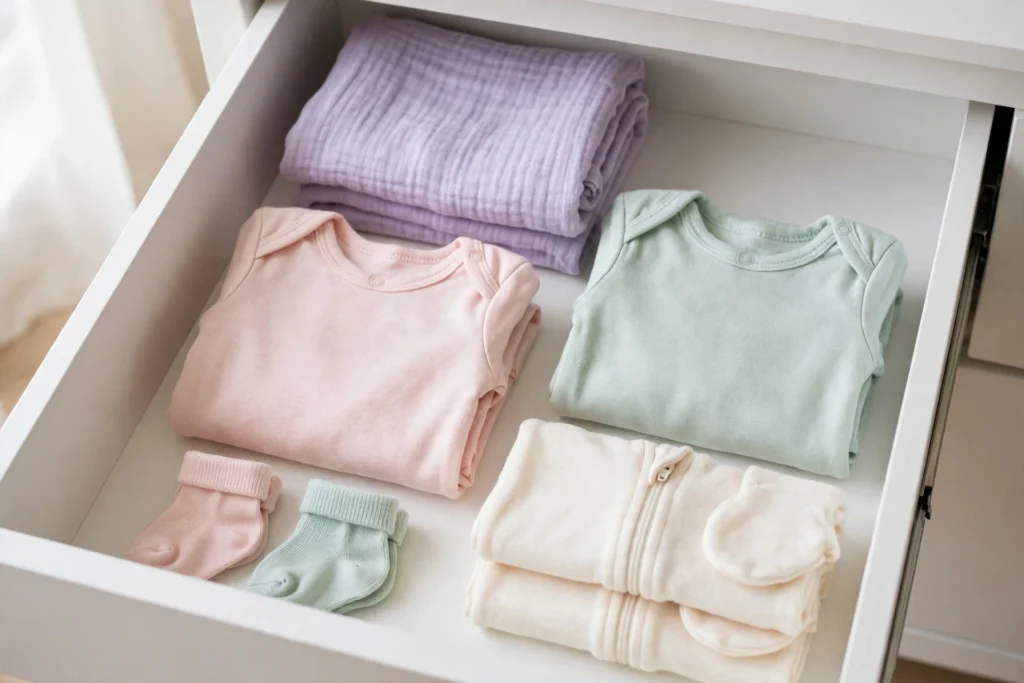
A practical starting wardrobe: 6–10 bodysuits in short and long sleeves for the season, 4–6 zippered footed sleepers, 2–3 hats, 4–6 pairs of socks, and 2–3 swaddles or sleep sacks. Choose zippers over snaps for night changes — at 3 a.m., a zipper is a gift.
Size is the trap. Buy only a few pieces in newborn size and put about 60% in 0–3 months — most babies outgrow newborn sizes within 2–4 weeks. Laundry every day means 5–7 bodysuits and 3–4 sleepers will do; twice a week means aiming for the higher end. Skip newborn shoes and separate pants in the first weeks; footed sleepers do the job.
Pick two-way zippers. Snaps take a minute and a light; a zipper takes five seconds in the dark. Parents who buy snaps first almost always buy zippers second — start with zippers.
5. Bathing, Grooming and Health: Keep It Simple
Bath time with a newborn is short, gentle and infrequent — about three baths a week is plenty, with sponge baths until the umbilical cord stump falls off, usually within 1 to 2 weeks. You need very little: a small baby tub, a mild fragrance-free wash, 4–6 soft washcloths, 2–3 hooded towels, and a soft-bristle brush. Keep the water warm, never hot, and set your water heater so the hottest tap water is no more than 120°F.
For grooming and health, one small kit covers the first months: a digital thermometer, baby nail clippers or a file, saline drops with a bulb syringe, and a basic first-aid kit. The thermometer is the one item to buy before the birth and know how to use. A temperature of 100.4°F or higher in a baby younger than 3 months means calling your pediatrician right away.
Skip the bath thermometer, wipe warmer and bottle warmer — warm tap water and room-temperature wipes work fine.
6. Travel and Outings: Car Seat First, Then the Diaper Bag
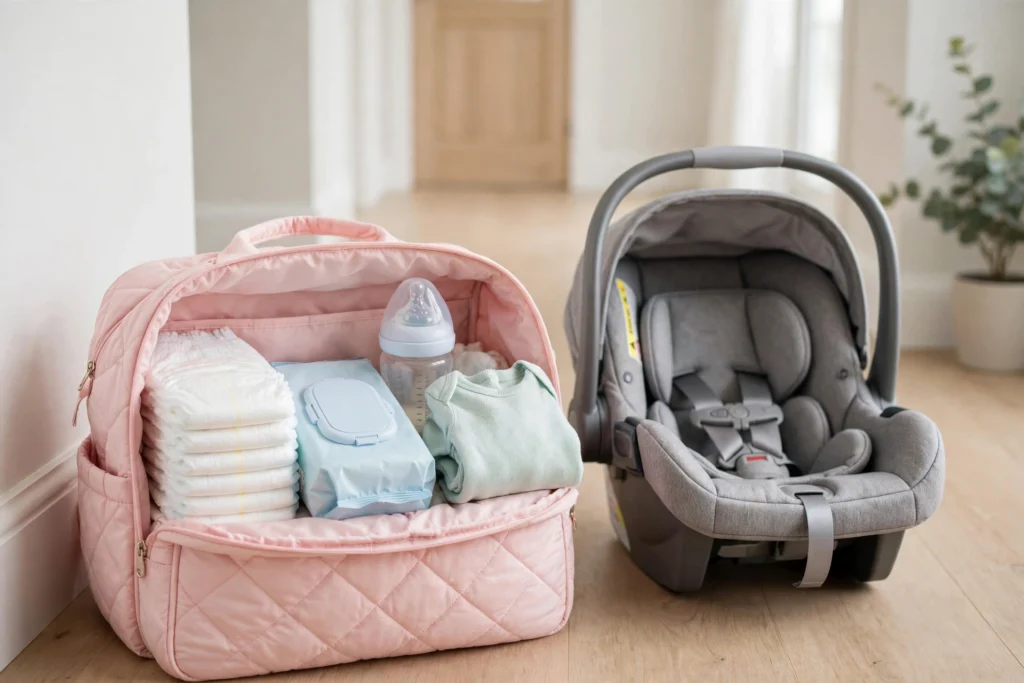
The most important travel item is the one you need before you leave the hospital: a rear-facing infant car seat, installed before your due date. Hospitals require one for the ride home, so install it early and have the fit checked.
Next comes the stroller or a baby carrier. Walk a lot and a stroller with a bassinet attachment earns its place; live small or use public transport and a wrap or structured carrier may be better, keeping your hands free. You do not need both on day one.
Then pack the diaper bag light. For a short trip: 3–4 diapers, wipes, diaper cream, one spare outfit, a burp cloth, and feeding supplies. For a longer day, double the diapers and add a second outfit and a blanket. A compact bag you can carry one-handed beats a large one that becomes extra luggage.
7. Nursery and Home Setup: One Corner, Not a Showroom
You do not need a finished nursery — just one safe, organized corner: a crib or bassinet, a changing pad on a low dresser, a comfortable feeding chair, and a small basket of supplies. The chair matters more than the decor: you will sit in it for hours, so choose one with arm support.
Keep nursery decor simple: soft pastel colours, nothing hanging over the crib. Our guide to budget-friendly baby shower decorations that look expensive has styling ideas for a nursery wall, and our baby shower backdrop ideas can inspire a photo corner.
Do not forget the parent: a water bottle by the feeding chair, comfortable clothes, postpartum supplies and a phone charger. If family ask what to bring, point them at our group baby shower gift ideas — one shared bigger item beats five small ones you did not ask for.
Newborn Essentials at a Glance
| Category | Start with (before birth) | How many | Can wait until after birth |
|---|---|---|---|
| Safe sleep | Bassinet or crib, firm mattress, fitted sheets, mattress protector | 1 sleep space; 2–3 sheets; 2–3 swaddles or sleep sacks | Baby monitor, blackout curtains, nursery decor |
| Diapering | Newborn + Size 1 diapers, unscented wipes, diaper cream, changing pad | 8–10 diapers a day; 1–2 small packs per size to start | Bulk diaper boxes, branded disposal system, wipe warmer |
| Feeding | Nursing bras + pads, nipple cream, nursing pillow; or 4–6 bottles, brush, drying rack | 4–6 bottles to start; 6–10 burp cloths | Extra bottles, breast pump, high chair, sippy cups |
| Clothing | Bodysuits, zippered sleepers, hats, socks, swaddles | 6–10 bodysuits; 4–6 sleepers; 2–3 hats; 4–6 pairs of socks | 3–6 month sizes, dress-up outfits, newborn shoes |
| Bathing & health | Baby tub, mild wash, washcloths, hooded towels, digital thermometer, nail file, saline + bulb syringe | 1 tub; 4–6 washcloths; 2–3 towels; 1 of each health item | Bath thermometer, bottle warmer, baby lotion |
| Travel | Rear-facing car seat (installed), diaper bag, carrier or stroller | 1 car seat; 1 bag; 1 carrier or stroller to start | Second stroller, travel crib, car-seat extras |
What You Can Skip (and What to Buy Second-Hand)
The fastest way to save money is to skip products marketed hard and used rarely. Crib bumpers, quilts, pillows, inclined sleepers, loungers used for sleep, weighted sleep sacks and sleep positioners are unsafe for sleep. Wipe warmers, bottle warmers and bath thermometers are conveniences, not needs.
Second-hand is smart for the big items, with one exception: buy the car seat new, or accept one only from someone you trust, with its full history and no accident damage, and check it has not expired or been recalled. Cots, dressers, strollers, carriers, baths and clothing are good second-hand buys. For spending, see how much a baby shower costs and our best baby shower gift basket ideas.
A car seat that has been in a crash, is missing parts, or is past its expiry date may not protect your baby. Buy new, or take one only from a person you trust who can tell you its full history — and check it against current US recall lists first.
Your Newborn Essentials Checklist
- Safe sleep space: firm mattress, 2–3 fitted sheets, protector, 2–3 swaddles or sleep sacks.
- Rear-facing car seat, installed and checked before your due date.
- 1–2 small packs each of newborn and Size 1 diapers; unscented wipes; diaper cream; changing pad.
- 6–10 bodysuits, 4–6 zippered sleepers, 2–3 hats, 4–6 pairs of socks — mostly 0–3 months.
- Feeding supplies: nursing bras, pads, cream and pillow, or 4–6 bottles, brush and drying rack.
- 6–10 burp cloths in the nursery, living room and diaper bag.
- Baby tub, mild wash, 4–6 washcloths, 2–3 hooded towels.
- Digital thermometer, nail file, saline drops and bulb syringe, first-aid kit.
- Diaper bag packed light, with spares in the car.
- Stroller or baby carrier.
- Feeding chair, night-light, water bottle and charger by the chair.
- Receipts kept, so the wrong size or brand can go back.
Frequently Asked Questions
What are the most important newborn essentials for first-time parents?
The most important newborn essentials for first-time parents are a safe sleep space, an installed rear-facing car seat, diapers and unscented wipes, a small clothing rotation, feeding supplies for your method, and a digital thermometer. Those six groups cover everything a newborn uses daily; almost everything else can wait.
How many diapers does a newborn need per day?
A newborn needs about 8–10 diapers a day, with wet diapers reaching about 8 a day by days 3 to 5, plus dirty ones. Start with 1–2 small packs each of newborn and Size 1, and do not stockpile newborn size — most babies outgrow it within a week to a month.
How many onesies and sleepers does a newborn need?
Start with 6–10 bodysuits (onesies) and 4–6 zippered footed sleepers, plus 2–3 hats and 4–6 pairs of socks. Laundry every day means 5–7 bodysuits and 3–4 sleepers are enough; twice a week means aiming higher. Put about 60% in 0–3 months — most babies outgrow newborn size in 2–4 weeks.
What newborn essentials can wait until after the baby arrives?
Extra bottles, more clothing in larger sizes, a breast pump, a high chair, sippy cups, a baby monitor, blackout curtains, nursery decor, bulk diaper boxes and a second stroller can all wait. Buy them once you know your baby’s size, feeding method and routine.
What newborn items should first-time parents skip?
Skip crib bumpers, quilts, pillows, sleep positioners, nests and pods, inclined sleepers and loungers for sleep, and weighted sleep sacks — none are safe for sleep. Skip wipe warmers, bottle warmers and bath thermometers too. Skip newborn shoes and piles of dress-up outfits — footed sleepers do the job.
Final Thought
The newborn essentials for first-time parents are fewer than the stores suggest: a safe place to sleep, an installed car seat, enough diapers for 8–10 changes a day, a small rotation of soft clothes, feeding supplies that match your method, and a thermometer you know how to use. Buy those before the birth and keep the receipts. If family want to help, share our best baby shower gifts for first-time parents and what to buy for a baby shower when parents already have everything — and for timing, our baby shower timeline keeps the last eight weeks calm and organized.