

Baby Shower Etiquette for Expecting Mothers and Their Families
Direct answer: Baby shower etiquette for expecting mothers is simple: someone close to you hosts and pays, you approve the guest list, gifts are never demanded, and thank-you notes go out within two to three weeks. The old rules have relaxed — mothers, mothers-in-law and even the parents-to-be can host — but graciousness, not tradition, is what guests remember.
Nobody hands you a rulebook when you get pregnant, yet everyone around you has opinions about your baby shower. Modern baby shower etiquette has one simple test: is it kind, is it honest, and does it put the mom-to-be at ease?
Who Hosts a Baby Shower?
Traditionally, a close friend or a not-so-immediate relative — an aunt or a cousin — hosted, because immediate family hosting looked like asking for gifts.
That rule has relaxed. Today anyone close to the parents-to-be can host: a best friend, a sister, a mother, a mother-in-law, a coworker, or a group co-hosting together.
The parents-to-be hosting their own shower still draws debate, but it is no longer considered rude, and it is increasingly common when family lives far away or nobody has offered. Keep it small and casual. Our guide to who traditionally hosts a baby shower covers the history and the modern exceptions.
Whatever the arrangement, the mom-to-be should have a say in the guest list and the style of the party. Give real input, then let the host actually host — approving every napkin colour is micromanaging, and it is the fastest way to turn a generous offer into resentment.
Many expecting mothers wait silently for someone to offer, and nobody does. It is fine to say, “I would love a small shower — would anyone like to host with me?”

Who Pays for a Baby Shower?
The host pays. Whoever offers to host takes on the cost of the party, just as they take on the planning. The mom-to-be is not expected to pay for her own shower, and guests are never expected to chip in.
In practice, showers are often a group effort — several aunts and cousins splitting a restaurant shower, or coworkers each covering one piece. When co-hosts split costs, agree on the split early, in writing, before anyone spends anything. Our guide to how much a baby shower costs gives realistic ranges for home showers, venue showers, food, and decor.
Hosts should plan a party within their means — a home shower with homemade food and simple decorations is often the warmer one. If the mom-to-be wants to contribute, she can offer something small, like the favors. And if you host a shower for someone, that is your gift; you do not also need to buy a second one.
The Guest List: Who to Invite — and Who Not to Invite
The golden rule is simple: invite only the people the parents-to-be are genuinely close to, and who would be happy to celebrate the new arrival. A shower is an intimate gathering, not a reunion of everyone the honoree has ever known.
The mom-to-be should approve the final guest list — the single best way to prevent the “Why wasn’t I invited?” conversations that follow a shower. If the host’s budget or space limits the number of guests, the host should give the mom-to-be that number first and let her choose who fills it. Our guide to how many guests to invite helps you size the list to the space and budget.
Who should not be invited? Anyone with a history of conflict with you or the other parent, anyone openly critical or unsupportive of your pregnancy, and anyone whose presence would make the celebration tense rather than joyful. You do not owe an invitation to someone simply because they are related to you. That includes the difficult mother-in-law question, raised in real forums again and again: expecting mothers who have not spoken to a mother-in-law in years and dread the tension she would bring. There is no single right answer — invite her, leave her off the list, or host a small separate lunch with close family. Decide it with your partner, decide it early.
Registry Etiquette for Expecting Mothers
Creating a registry is entirely proper. A registry is not a demand — it is a map that tells gift-givers what you actually need.
The etiquette question is how the registry information reaches guests. Traditionally, details came from the host, not the parents-to-be. The modern version: put registry details on a separate insert, or on a details page for a digital invitation. For invitation wording, see our guide to baby shower invitation etiquette.
Finish the registry before invitations go out, and include gifts at a wide range of price points, so every guest can find something comfortable. Include a gift receipt option wherever possible, because duplicates happen even with a registry. Buying off-registry is always allowed — the best off-registry gifts are personal ones, like a favorite childhood book. If the registry is sold out, diapers and wipes are the safest fallback.
A registry nobody can find helps nobody. Ask your host to put the link on the invitation insert, and check it yourself before invitations go out.
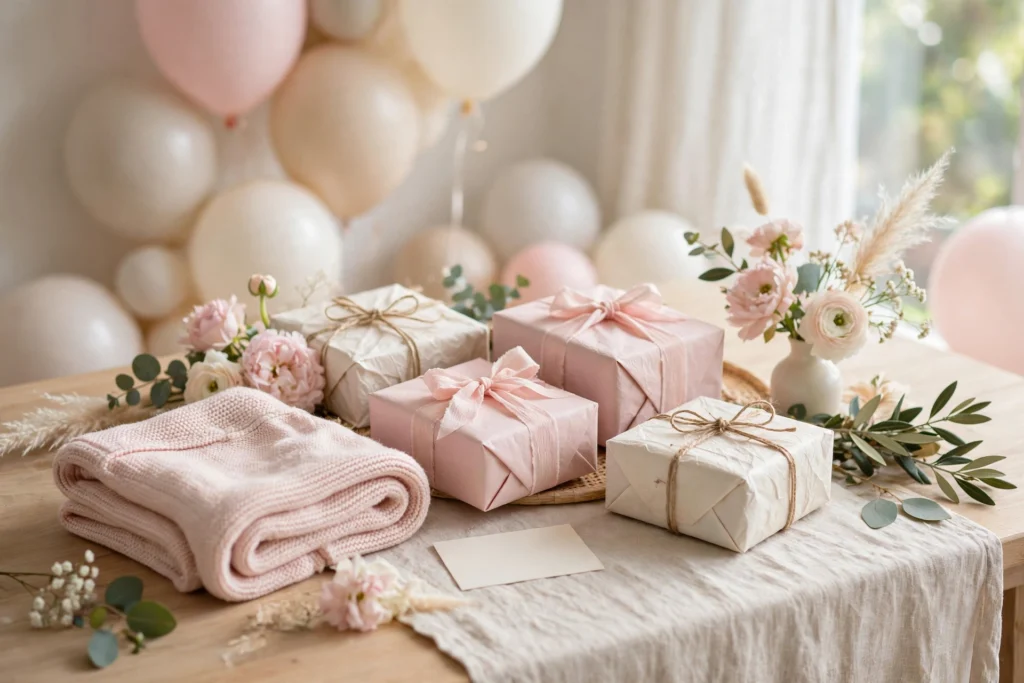
Gift Expectations: How Much, What to Give, and Opening Gifts
How much should a guest spend? There is no single correct number. What the ranking guides agree on is a range shaped by the relationship and the guest’s budget: coworkers and acquaintances typically spend around $25 to $40, good friends around $50 to $75, and close family or best friends around $75 to $100 or more, with group gifts running about $15 to $25 per person. All of these are ranges, not requirements, and prices vary by US region and retailer. Spend what you are comfortable spending.
What should guests give? Practical gifts top every list: diapers, bottles, onesies, blankets, and bigger gear like car seats and strollers. See our guides to the best baby shower gifts for first-time parents and affordable baby shower gifts under $50.
Do you have to open gifts in front of everyone? Traditionally, yes. Today, it is the parents’ choice: opening in front of guests is lovely, but opening privately afterwards is also fine, especially at a large shower. Whatever you receive, react graciously in the moment.
Thank-You Notes: Timing, Tracking, and What to Write
Thank-you notes are the one part of baby shower etiquette that has not relaxed. They are still expected, and guests notice most when they do not arrive. Every person who attended or sent a gift gets a note — including each person who contributed to a group gift.
Aim for two to three weeks after the shower, while gifts and givers are still fresh and before the baby arrives. Babylist’s guidance is two weeks; Emily Post’s is simpler: as soon as possible. But two weeks is a goal, not a deadline anyone enforces. Up to three months is widely considered acceptable, and a note that arrives six months late still beats a note that never comes. Late is fine. Never is the failure.
The real failure mode is not lateness — it is not tracking who gave what. Ask someone to write down each gift and giver as you open. What should the note say? Three lines are enough: thank them, name the specific gift and how you will use it, and close warmly. For wording ideas, see our guide to baby shower thank-you card wording.
Before the shower starts, hand one trusted person a notebook and ask them to write down every gift and giver as you open. It takes ten minutes and saves hours of guessing later.

Second Showers, Sprinkles, and Multiple Showers
Can you have a baby shower for a second or third baby? Yes. What changes is the shape: a second shower is usually smaller and more relaxed, often called a baby sprinkle — a light “sprinkling” of gifts. The sprinkle registry focuses on what you actually need this time: diapers, wipes, and clothes for a different season or sex.
Multiple showers are also normal now — one with family, another with friends, and a small office celebration. The rule that protects everyone is simple: do not invite the same people to more than one shower. If a few very close people attend more than one, make it clear they need not bring a second gift.
Workplace Showers
Office baby showers have their own etiquette, and it is mostly about restraint. Keep the celebration during lunch hour or right after work, keep participation completely optional, and keep the format simple — cake, a few gifts, and a card everyone signs. Contributions to a group gift should be voluntary and private — never pass around a collection envelope with amounts visible. If there was already an office shower, skip inviting those coworkers to the family shower. If the expecting mother works remotely, a short virtual celebration with the same light format works just as well.
Tricky Family Situations
Most guides stick to the easy questions. The questions real families lose sleep over are harder.
Two people both want to host. This is the most common family tension, usually a mother and a mother-in-law. The kindest solution is co-hosting: one handles the venue and food, the other handles decorations and games, and both names go on the invitation. If co-hosting would create more friction, the mom-to-be should choose one host — privately and early — and give the other a visible role.
Divorced or separated parents. Both can be invited — give each a comfortable role, seat them apart, and do not ask the mom-to-be to manage their relationship on the day.
The mom-to-be is being micromanaged — or is doing the micromanaging. If the host feels the mom-to-be is planning everything while the host pays and does the work, the host should say so early and kindly. If the mom-to-be feels the host is ignoring her wishes, she should speak up before invitations go out, not after.
The shower is a surprise and the mom-to-be hates surprises. Then it should not be a surprise.
The expecting mother is the guest of honor, not the mediator. If two relatives are in conflict, they should sort it out between themselves — or the host should decide. Asking a pregnant woman to referee her own celebration is the etiquette mistake that genuinely ruins showers.

What the Mom-to-Be Is (and Isn’t) Expected to Do
Your only real job at your own baby shower is to be a gracious guest of honor: sit, enjoy your guests, and let people celebrate you.
There are a few things you may want to offer — not because etiquette demands them, but because they make the day smoother. You can also say clearly what you do not want — no games, no surprise, no gift opening in front of everyone — because a host cannot respect a preference she does not know.
What you are not expected to do: pay for the party, plan it, clean up after it, or manage anyone else’s feelings about it. You are not expected to invite people you do not want there, or pretend to love a gift you do not. Most showers last about two hours, and a good host will build in a quiet corner and a comfortable chair for you.
Baby Shower Etiquette at a Glance
Use this table as a quick reference — who does what, and when.
| Question | The etiquette answer | Who is responsible |
|---|---|---|
| Who hosts? | A close friend, sister, mother, mother-in-law, or co-hosts | The host (or hosts) |
| Who pays? | The host pays; co-hosts split costs agreed in advance | The host / co-hosts |
| Who approves the guest list? | The mom-to-be approves it; invite only people genuinely close to her | Mom-to-be + host |
| Registry details? | Shared by the host on an insert, before invitations go out | Mom-to-be creates it; host shares it |
| How much should guests spend? | $25–$40 coworkers, $50–$75 friends, $75–$100+ close family — ranges only, prices vary by US region and retailer | Each guest, by comfort |
| Must gifts be opened at the party? | No — opening in front of guests is traditional but optional | The parents-to-be decide |
| Thank-you notes? | Yes, to everyone who gave a gift; aim for 2–3 weeks, late still beats never | The mom-to-be |
| Second shower or sprinkle? | Yes — keep it smaller, don’t invite the same guests twice | Host + mom-to-be |
Your Baby Shower Etiquette Checklist
- Decide who hosts — and agree it out loud, not by assumption.
- Agree on who pays and how co-hosts split costs, before anyone spends.
- Host shares registry details on an insert, not the invitation itself.
- Appoint a gift logger before the shower starts.
- Plan for about two hours, with a comfortable seat for the mom-to-be.
- Send thank-you notes within two to three weeks; late still beats never.

Frequently Asked Questions
Can the mom-to-be host her own baby shower?
Yes. The old rule has relaxed: if nobody has offered, or family lives far away, the parents-to-be can host their own shower. Keep it small and casual.
Who pays for a baby shower — the host or the family?
The host pays. Co-hosts split costs, agreed in advance. The mom-to-be is not expected to pay.
Is it rude to have a baby shower for a second baby?
No. Second showers — often called baby sprinkles — are widely accepted. Keep it smaller than the first and don’t invite the same guests twice.
How long do I have to send baby shower thank-you notes?
Aim for two to three weeks, while gifts and givers are fresh. Two weeks is a goal, not a deadline: up to three months is acceptable, and a late note still beats one that never comes.
Do I have to invite my mother-in-law to my baby shower?
No rule forces you to invite anyone, including a relative. Invite people you are genuinely close to. If the relationship is strained, invite her, leave her off the list, or host a small separate lunch — and decide it with your partner, early.
Final Thought
Baby shower etiquette for expecting mothers comes down to something simpler than the old rulebooks made it sound: let someone who loves you host, approve the guest list yourself, accept gifts graciously, and thank people properly. Plan the party around the mom-to-be, not around the rules, and the etiquette will take care of itself. For the full plan, see our guide to how to plan a baby shower; for the backdrop and photos, see our baby shower backdrop ideas; and for timing, our baby shower timeline.