
Baby Shower Invitation Etiquette: Everything Hosts Should Know
Direct answer: Baby shower invitation etiquette is simple at its core: invite only the people the parents-to-be genuinely want there, put every essential detail on the invitation, set a clear RSVP deadline, and state plainly whether partners and children are included. Most US hosts send invitations four to six weeks before the shower, use a separate insert or a linked page for registry details if they want a cleaner main card, and never use the invitation to demand gifts, receipts, or a minimum spend.
Why invitation etiquette matters more than the design
A beautiful invitation cannot rescue a confusing one. Guests decide from a single card whether they are invited, who else is invited, where to go, what time to arrive, and how to reply. When any of those answers is missing, the host spends the next few weeks answering the same questions one by one, and guests who are unsure often stay home rather than ask.
Good etiquette is about removing guesswork, so guests feel welcome and hosts avoid awkward follow-ups about plus-ones, children, gifts, and dress codes.
Who should be on the guest list?
Start with the parents-to-be, not with a venue capacity or a family obligation list. Ask them, in private, who they most want in the room. Then build outward in circles: immediate family and closest friends first, then extended family, coworkers, and wider friends, stopping when you reach a comfortable size for the space and budget.
This matters because a baby shower is a personal celebration, not a public announcement. Inviting someone out of duty, while leaving out someone the parents love, creates tension that no decoration can hide. If the parents ask you to leave someone off, honour that request even when it feels awkward. The invitation list belongs to them.
For more on sizing the list, see our guide to how many guests to invite to a baby shower.
Before you order a single invitation, send the draft list to the parents-to-be and ask two questions: “Is anyone here you would rather not invite?” and “Is anyone missing who would break your heart if they were not there?” That five-minute check prevents almost every guest-list regret.
What must be on every invitation?
Every baby shower invitation, digital or printed, needs the same seven essentials. Leave one out and guests will message you about it.
- The name or names of the guest or guests of honour
- The host’s name, so guests know who to thank and who to contact
- The date, with the day of the week spelled out
- The start time and the end time, not just a start time
- The full venue name and address, or a clear link for a virtual shower
- How to RSVP, with a name, a method, and a reply-by date
- Any detail that changes what guests should do: surprise, dress code, theme, diaper raffle, or book request
Use full names on envelopes and digital invites, not nicknames, and address the invitation to exactly the people invited. If only one partner is invited, address it to that person alone. If children are invited, say so. Guests should never have to guess from the envelope whether their family is included.
A simple wording checklist
- “You are invited to a baby shower honouring [Name]”
- “Hosted by [Host name]”
- “Saturday, [date] from 2:00 to 4:00 p.m.”
- “[Venue name], [full address], [city, state]”
- “Please RSVP by [date] to [name] at [phone or email]”
- Optional line: “Registered at [store or registry link]” or a note that registry details are on the enclosed card
For ready-made phrasing, see our baby shower invitation wording examples.
Registry etiquette: the question every host asks
This is where etiquette advice splits, and US guests genuinely disagree. Traditional etiquette said registry details should not appear on the invitation itself, because it can read as asking for gifts. Modern practice is more relaxed: many guests actively want registry details so they do not buy duplicates or guess at sizes and colours.
The tidy middle path works for almost every shower. Put registry details on a separate enclosure card inside a printed invitation, or on a linked details page for a digital invitation, rather than in the main invitation wording. Guests who want the registry will find it instantly, and the main invitation stays focused on the celebration itself.
What you should never do is use the invitation to set expectations about gifts. Do not ask for receipts, do not state a price range, do not say “no clothes” or “cash only,” and do not suggest that a gift is required for entry. If the parents already have plenty of one item, the host can mention it privately when guests ask, or the registry itself can steer choices by what it includes and leaves out.

Lines like “please include receipts,” “gifts over $50 only,” or “no gift, no entry” embarrass guests and put the parents-to-be in an awkward position. If a guest asks what to bring, point them to the registry or suggest a practical item in conversation — never on the invitation.
RSVP etiquette that actually gets replies
An RSVP date is not decoration. Caterers, venues, favour counts, and seating all depend on it, so give guests a deadline they can meet and a method they will actually use. Two weeks before the shower is a sensible reply-by date for most US showers, with one friendly reminder a few days after the deadline for non-responders only.
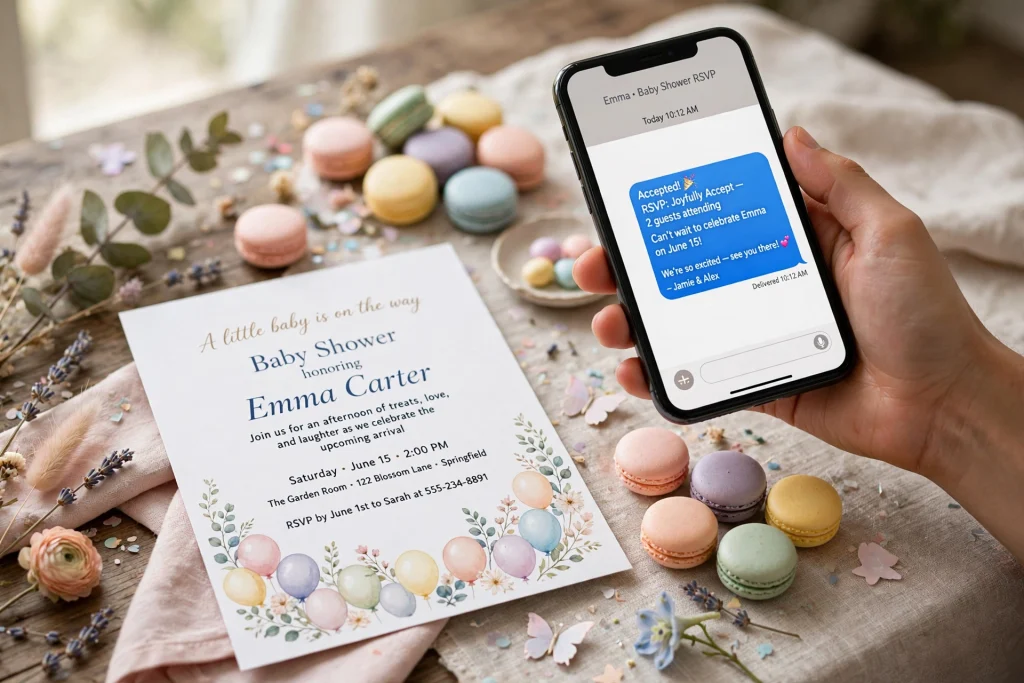
Make replying easy. One contact person, one clear method, and no requirement to create an account or download an app unless the whole guest list is comfortable with it. For printed invitations, a phone number or email works well. For digital invitations, a built-in RSVP button is even easier, and it lets the host track responses without a spreadsheet.
Plus-ones, partners, and children: say it plainly
No part of baby shower etiquette causes more confusion than plus-ones and children, and the fix is one clear sentence. Guests cannot tell from tradition alone whether a shower is women-only, co-ed, family-friendly, or adults-only, because all of those versions are now common in the US.
State it on the invitation, for example:
- “Partners are warmly welcome — please let us know if yours can join us.”
- “This will be an adults-only celebration, and we appreciate your understanding.”
- “Little ones are welcome; please include their names in your RSVP so we can plan seating.”
- “You are invited — please join us solo for this one, as space is limited.”
Name long-term partners on the invitation when they are invited. “And guest” is fine for a new relationship, but a partner of many years deserves a name. For children, ask for names and ages in the RSVP if seating, food, or activities depend on the count.
Surprise showers, co-ed showers, and second showers
Surprise showers need extra care on the invitation. Say “Surprise!” at the top and again near the RSVP details, and give an arrival time earlier than the parents-to-be’s arrival time. Ask guests not to mention the shower on social media or in group chats where the parents might see it. One leaked post can undo weeks of planning.
Second showers, often called sprinkles, follow the same rules with a lighter touch. See also our guide to who traditionally hosts a baby shower.

Give guests a decoy plan to use if the parents-to-be ask what they are doing that day, such as “brunch with friends.” One agreed cover story stops ten improvised ones, and it keeps well-meaning guests from accidentally spoiling the surprise.
Digital invitations: does etiquette change?
Digital invitations are fully acceptable for baby showers in the US today, including formal showers, as long as the invitation itself is complete and easy to read. What changes is delivery, not manners. A digital invitation still needs every essential detail, a clear RSVP method, and a personal touch — a short note to the guest, not just a forwarded link.
Be thoughtful about your guest list’s comfort with technology. Older relatives, guests without reliable email, and anyone who treasures a keepsake may appreciate a printed invitation even when most guests receive a digital one. A hybrid approach — digital for most guests, printed for a small group — is polite, not inconsistent.
Compare formats in detail in digital vs. printed baby shower invitations.
Common etiquette mistakes to avoid
| Mistake | Why it causes trouble | What to do instead |
|---|---|---|
| No end time on the invitation | Guests cannot plan childcare or travel | Always print a start and end time |
| Vague plus-one wording | Guests bring unplanned extras or stay home | State plainly who is invited |
| Registry demands on the main card | Feels like a bill, not a celebration | Use an enclosure card or linked page |
| No RSVP deadline | Host cannot confirm food or seating | Set a deadline about two weeks before |
| Inviting by public post only | Guests are unsure if they are included | Send private invitations to named guests |
| Last-minute invitations | Guests cannot arrange travel or time off | Send four to six weeks ahead where possible |

Read the invitation once as a guest who knows nothing about the shower. Can you answer who, when, where, how to reply, and who else may come, without asking anyone? If yes, the etiquette is right. If not, add the missing line before you send — not after.
Host checklist: before you send
- ☐ Guest list approved by the parents-to-be
- ☐ Full names and correct addresses or emails collected
- ☐ Date, start time, and end time confirmed with the venue
- ☐ Host contact and RSVP deadline on the invitation
- ☐ Plus-one and children policy stated plainly
- ☐ Registry details on an enclosure card or linked page, not as a demand
- ☐ Surprise wording added twice, if applicable
- ☐ One proofread by someone other than the host
- ☐ Test digital invitation on a phone before sending to everyone
When timing is your next question, read when to send baby shower invitations and our baby shower planning checklist for hosts.
Frequently asked questions
Is it rude to put registry information on a baby shower invitation?
Not necessarily. Many US guests prefer knowing where the parents are registered, and modern etiquette accepts it. The safest approach is a separate enclosure card for printed invitations or a linked details page for digital ones, so the main invitation stays focused on celebrating rather than shopping.
Who should you not invite to a baby shower?
Do not invite people the parents-to-be do not want there, people invited only out of obligation who would make the parents uncomfortable, or an entire group minus one person. When in doubt, ask the parents privately and follow their answer.
Should baby shower invitations include plus-ones?
Only if plus-ones are genuinely invited. Name long-term partners individually, state the policy plainly for other guests, and ask for plus-one names in the RSVP so catering and seating stay accurate. Never assume guests will know from tradition alone.
Is a digital baby shower invitation rude?
No. Digital invitations are widely accepted in the US, including for formal showers, provided they include every essential detail and are sent privately to named guests. Consider printed invitations for older relatives or guests who prefer paper.
Can family members host a baby shower?
Yes. While tradition once favoured friends as hosts, it is now completely normal for a sister, mother, aunt, partner, or friend to host, and for several people to co-host. What matters is that the parents-to-be are comfortable with the plan.
What if a guest brings an uninvited plus-one or child?
Welcome them graciously on the day if space and food allow, and speak to the guest privately later only if it caused a real problem. A public correction at a celebration embarrasses everyone and overshadows the parents-to-be’s day.